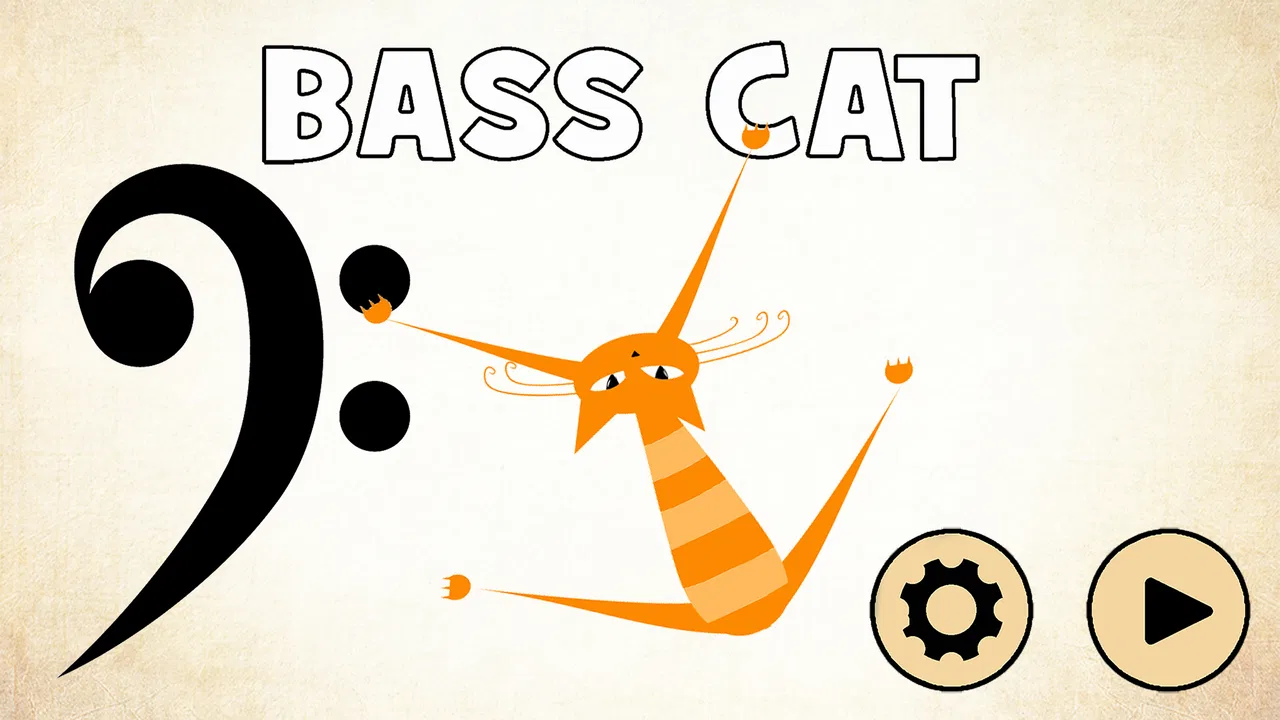
BASS CAT
- 3.9
- Rating
- 10.00K
- Installs
- $2.49
- Price
 Analysis by App-foxy
Learning to read bass clef can feel strangely slow when the notes are presented as dry exercises. BASS CAT takes a more direct route: it turns note recognition into a small music game where I identify what I see, receive immediate feedback, and try again. That simple action-feedback cycle is the reason it works better for short practice bursts than for long, formal lessons.
Developed by Melody Cats, this is a music game focused specifically on quickly recognizing notes in the bass clef. It is available for $2.49, carries an Everyone age rating, and has reached over 10K installs. Its average rating is 3.9 from around 84 ratings, which suggests a generally positive but not universally enthusiastic reception. After spending time with it, I can understand both sides: the central exercise is useful and pleasantly focused, while the narrow scope means it will not replace a complete theory course, a method book, or regular work with a teacher.
How the note-reading loop works
I focus here on the point where the exercise becomes useful: recognizing the staff position before reaching for an answer. I find it helps to name the note silently first, then respond, so speed grows from a deliberate reading habit rather than guesswork. That small distinction also makes it easier to spot which bass-clef positions still need attention.
You May Also Like

 AccuWeather: Weather Radar
AccuWeather Review: A Quick, Clear Forecast for Everyday Decisions
For everyday plans, the best forecast is the one you can understand quickly. AccuWeather makes rain timing, radar, and local conditions easy to act on, with a few trade-offs.

 Hill Climb Racing
Why Hill Climb Racing Still Turns Crashes Into One More Run
A tiny car, a bumpy hill and one more upgrade: Hill Climb Racing keeps resurfacing because its simple chaos makes every near-miss feel personal.

 AliExpress - Shopping App
AliExpress Makes Global Shopping Feel Personal, but Shoppers Bear the Risk
AliExpress turns a global marketplace into a pocket-sized discovery engine. Its reach is useful, its shopping loop compelling, and its trade-offs easy to miss.

 Lords Mobile: Kingdom Wars
Lords Mobile Is a Kingdom-Building Routine, Not a Quick Match
A case-by-case verdict on the building, battles, device demands, and social commitments that make Lords Mobile rewarding for some players and exhausting for others.

 PDF Scanner app - TapScanner
TapScanner Makes Paperwork Easier to Capture, Check, and Share
TapScanner makes scanning with a phone feel less like a rescue operation and more like a dependable step in getting work done. Its capture tools are useful, though not flawless.

 Block Blast!
 Shows How Much a Puzzle Game Can Leave Out
A quiet grid game shows why puzzle players increasingly value instant clarity, repeatable skill and low-pressure play—and where the genre still needs to catch up.
More From Our News Desk
View All News


The first action is immediate recognition
The most important thing about the game is what it asks me to do first. I am shown a bass-clef note and have to identify it quickly. There is no long setup before the useful part begins, so the app feels suitable for the moment when I have a few spare minutes and want to reinforce reading rather than study a large lesson.
That focus matters because bass clef often becomes a weak spot for players who are more comfortable with treble clef. I may know the note names in theory, yet still hesitate when reading the lower staff on a piano score. A game built around repeated recognition gives that hesitation somewhere specific to go. Instead of silently guessing while playing a song, I can isolate the visual skill and work on it directly.
I also like that the task is concrete. The game does not ask me to memorize a broad explanation before allowing practice. The staff, the note, and my answer form the whole starting point. For a beginner, that makes the first session less intimidating. For someone returning to music after a break, it provides a quick way to find out whether bass-clef reading is still automatic or has become dependent on counting upward from a familiar reference.
The trade-off is that recognition is not the same as full musical reading. A player still needs to understand rhythm, rests, key signatures, intervals, articulation, and how notes relate to an instrument. BASS CAT addresses one narrow but important piece of that puzzle. I see it as a drill for visual fluency, not as a complete path from first lesson to confident performance.
Feedback creates a useful rhythm
The game’s feedback is what keeps the exercise from feeling like a worksheet. I make a choice, find out whether I recognized the note correctly, and immediately have a reason to pay attention to the next one. That rhythm is more engaging than writing answers in a notebook because every response leads straight into another decision.
For me, the best use is not to chase speed blindly. The real goal is to reduce the pause between seeing a note and knowing its name. If I answer too quickly and rely on a lucky guess, the game can expose that weakness on the next attempt. If I slow down enough to notice the staff position, I can turn each mistake into a small correction rather than treating it as a failure.
A practical routine is to begin with deliberate answers, even when the app encourages quick recognition. I first look at the line or space, name the note, and then gradually shorten the pause. This builds a more dependable association than memorizing a visual shape from one isolated question. I also find it useful to say the note name quietly before tapping, because that connects the visual response to the spoken language musicians use during lessons and rehearsals.
There is a subtle limitation here. Fast feedback can tell me whether an answer is right, but it does not necessarily explain why a wrong answer happened. If I confuse neighboring notes, I need to diagnose that pattern myself. The app is strongest when I already know the basic structure of the bass staff and need repetition. A complete beginner may benefit from learning the staff landmarks elsewhere before expecting every mistake to teach itself.
Why the reward is another attempt
The reward in this game is not a large collection of instruments, a story, or a complicated progression. It is the small satisfaction of getting the next note right and feeling the recognition become less effortful. That may sound modest, but it fits the skill being trained. Reading music improves through many accurate encounters, and the game gives those encounters a reason to continue.
I especially appreciate the way the reward can be personal rather than purely numerical. At the start of a session, I may still be translating each note consciously. After several rounds, I notice that some positions become familiar at a glance. That change is the result I am looking for. The game gives me a compact environment where I can notice progress without needing to play an entire piece or wait for a teacher to check my work.
This makes it a good companion for several kinds of musicians. A beginner learning the lower staff can use it to support piano lessons. A singer who reads vocal parts may use it to strengthen general staff awareness, although the bass-clef focus will only help if that notation appears in the music they use. A returning player can use a short session before practicing repertoire as a mental warm-up. Even a more experienced musician may find value in it when bass clef is familiar but not instantly readable.
It is less convincing for anyone looking for a broad game-like reward system. If I expect unlockable content, a musical adventure, or a deep progression structure, this will feel sparse. The appeal comes from repetition and improvement, not from collecting virtual items. That is an important distinction before paying for it.
Resetting the session without losing the lesson
The reset is part of the appeal. I can finish a short run, put the app down, and return later without needing to prepare a study plan. That makes the game fit naturally into a day with uneven gaps: a few minutes before a lesson, a quick break between practice tasks, or a final exercise before closing the instrument.
Short sessions are also helpful because note recognition can become less useful when I am tired. Once I start tapping mechanically, I am no longer building careful visual associations. Stopping and returning later gives the skill a chance to stay fresh. I would rather complete several focused bursts than force one long session and confuse speed with learning.
One of my favorite ways to use this kind of reset is as a bridge into real music. I begin with a few rounds, then open a bass-clef passage on the piano and see whether the notes feel easier to locate. The game itself does not replace that transfer step. The actual test is whether the recognition survives when notes appear in a phrase, beside other symbols, and within a rhythm. Used this way, the reset is not an ending; it is a prompt to apply the skill somewhere more musical.
There is also a useful trade-off between isolation and context. The clean game exercise removes distractions, which is excellent for building note-name speed. Real sheet music adds distractions, which is exactly why transfer can be difficult. I would not judge the app harshly for concentrating on one task, but I would make sure to pair it with reading real excerpts. Otherwise, I might become good at answering isolated prompts without becoming equally comfortable navigating a complete score.
Where it fits beside other learning options
Compared with flashcards, BASS CAT gives the same basic memory challenge a more active pace. Flashcards are flexible and can cover many subjects, but they often make me manage the repetition myself. Here, the game supplies a tighter sequence: look, answer, receive feedback, and continue. That structure is useful when motivation is the main obstacle.
Compared with a piano method book, it is much narrower. A book can introduce posture, rhythm, fingering, musical symbols, and pieces that gradually become more demanding. This game cannot provide that complete curriculum. Its advantage is concentration: when the exact problem is slow bass-clef identification, a page of theory may feel less direct than repeated visual practice.
Compared with a general ear-training app, the emphasis is different. Ear training asks me to recognize sound, intervals, chords, or melodic relationships. This game asks me to recognize written notes. Someone preparing for improvisation or trying to identify chords by ear may be better served elsewhere. Someone who keeps stopping while reading the lower staff is much closer to the intended audience.
A teacher can also do something the game cannot: observe why I hesitate and adjust the explanation. If I repeatedly confuse two positions, a teacher might connect them to a landmark, a fingering pattern, or a passage from my current repertoire. BASS CAT is therefore best as a supplement between lessons, not as a replacement for feedback from a knowledgeable musician.
Small habits that make practice more effective
I get more from the app when I treat each answer as a reading decision rather than a reflex test. Before responding, I locate the note on the staff and connect it to its name. With time, that process becomes faster. The point is not to preserve the slow method forever, but to make sure speed grows out of understanding.
Another useful habit is to keep the game tied to the instrument I play. After a session, I can find the same note on the keyboard or another instrument and play it. This creates a three-part connection between the written symbol, the spoken note name, and the physical location. That extra step is easy to skip, yet it helps prevent the exercise from becoming detached from actual musicianship.
I also recommend using it before a piece that contains a lot of bass-clef reading, rather than only when I feel stuck. A short warm-up can bring the lower staff into focus before the more demanding work begins. If the piece contains leaps or notes outside the most familiar area, I pay attention to whether the game has improved general recognition or only the easiest positions. That distinction tells me when I need to return to slower reading in the score itself.
Finally, I would avoid treating the average rating as a promise that every player will enjoy it. The 3.9 average reflects a decent level of satisfaction, but the experience depends heavily on whether isolated note drills match my learning style. Players who enjoy compact repetition may find it motivating. Players who need explanations, songs, or a rich progression may quickly feel that the exercise is too limited.
Practical details before downloading
The game costs $2.49, so the decision is fairly straightforward: I would pay that amount if bass-clef reading is a specific weakness and I want a focused practice tool. I would hesitate if I am searching for a free all-in-one music course or a game with substantial entertainment content. The price makes sense as a small specialist purchase, not as a substitute for a full learning platform.
It is rated for Everyone, which suits its educational subject and simple concept. The current version is 3.4, and it runs on operating systems version 10 or later. That requirement is worth checking before installing, particularly if I am using an older device. The app has been available since Aug 29, 2012, and its continued presence alongside over 10K installs suggests that it has found a stable niche among people looking for this particular exercise.
I would also set expectations around the word “game.” The interactive format makes practice less passive, but the musical content remains deliberately focused. I should not expect a soundtrack-driven experience or a large collection of modes simply because it is categorized as a game. Its game quality comes from the repeated challenge and the impulse to try one more round.
My verdict on the complete loop
The loop is clear and effective: I see a bass-clef note, make a quick identification, receive an immediate result, feel the small reward of accuracy, and reset for another attempt. The next session begins because I can sense a gap between knowing the notes and recognizing them instantly. That gap is exactly where this app is useful.
BASS CAT is worth considering when your main goal is faster bass-clef recognition, not broad music education. I would recommend it to beginners who already have a basic introduction to the staff, piano students who hesitate in the lower register, and returning musicians who want a compact refresher. I would skip it in favor of a fuller course, teacher-led study, or broader theory tool if I need rhythm instruction, ear training, repertoire, explanations, or a structured curriculum.
My final opinion is positive but specific. Melody Cats has made a narrow exercise easy to start and easy to repeat, and that narrowness is both its strength and its boundary. Used for a few focused minutes and followed by real score reading, it can turn bass clef from a pause-inducing symbol system into something more immediate. Used alone as a complete music-learning solution, it will feel incomplete. For the right learner, though, the simple cycle of action, feedback, reward, reset, and another try is enough to make a stubborn skill move forward.
FAQs for BASS CAT
01What is BASS CAT and what can I do with it?
BASS CAT is a music-focused application designed for people who enjoy exploring, practicing, or creating bass-driven sounds. Depending on the version and platform, it may offer bass lines, interactive controls, sound effects, practice tools, or a playful way to experiment with low-frequency music. The interface is generally aimed at casual users and music enthusiasts, although beginners should review the available controls before expecting a complete professional recording studio.
02Is BASS CAT suitable for beginners who have never played bass?
Yes, BASS CAT can be approachable for beginners because it provides a simple way to interact with bass sounds without requiring advanced musical knowledge. New users can usually start by testing the main controls, listening to different tones, and experimenting with rhythms or presets. However, it should be viewed primarily as an introductory or entertainment tool rather than a replacement for structured lessons, a physical bass guitar, or professional music-training software.
03Does BASS CAT require an internet connection to work?
The connection requirements may depend on the specific features included in the installed version. Basic sound playback or locally stored tools may work offline after installation, while updates, advertisements, online content, analytics, or additional sound packs can require internet access. Before downloading, users should check the app-store description and permission details. If offline use is important, test the main features after installation with mobile data and Wi-Fi disabled.
04Is BASS CAT free to download, and are there in-app purchases?
BASS CAT may be available as a free download, but free access does not always mean that every feature is included at no cost. Some versions can use advertising, optional purchases, premium sound content, or subscriptions to unlock additional functions or remove limitations. Pricing and purchase options can change according to the Android or iOS store, region, and developer updates, so review the current listing carefully before confirming any payment.
05What permissions and device requirements should I consider before installing BASS CAT?
Before installing BASS CAT, check whether your phone meets the listed operating-system and storage requirements, particularly if you are using an older Android or iPhone model. A music app may request access related to audio, notifications, storage, or the microphone, although the necessity of each permission depends on its features. Grant only permissions that make sense for the app, and review the developer’s privacy policy if you are concerned about data collection or advertising.
Pros
- Simple interface makes it easy to start creating bass lines quickly.
- Useful for practicing timing
- groove
- and basic bass note patterns.
- Lightweight app that should run smoothly on many older devices.
- Short sessions make it convenient for quick practice anywhere.
- Can help beginners explore bass sounds without owning an instrument.
Cons
- Limited depth may not satisfy experienced bass players or producers.
- Sound quality depends heavily on your device’s speakers or headphones.
- Touch controls may feel less precise than playing a physical bass.
- Some features or content may require additional purchases or ads.
- The app may offer limited variety in effects
- instruments
- or customization.

BASS CAT
Gallery